Today, I would like to talk to you about some of the features a Masternode can provide. Before that, let’s remind you how a Masternode works.
Basically, a Masternode is a node, which possess all the blockchain information and provides additional features to the network. Becoming one would let you receive a passive income for performing some services to users by making the network more secure and providing governance over the network (depending on the project).
After we cleared that out, let’s observe the most common features contributed by Masternodes
InstantSend
The name speaks for itself – Instant transactions. This feature prevents double-spending by locking the transaction in a “pending” status. The moment a user signs a transaction and uses this feature, it gets broadcasted to the nearest Masternode. This last one sends the transaction to all other Masternodes on the network and eventually forms a consensus with a certain number of randomly chosen Masternodes. They vote on the validity of this transaction and if everyone agrees it’s legit they broadcast it on the network as a ‘consensus transaction’. After a node receives all the confirmation messages, they can consider the transaction as confirmed. If a consensus is not reached between the Masternodes the transaction doesn’t fail but transforms in to a normal one.
Note that the transaction fee will be a little bit higher since you are using a “premium” service.
Private Send
The general idea here is to make the coins you send as hard as possible to trace, in aword to remove their history of movement. This is done by breaking down a user’s transaction input into several denominations like:
– 0.01 – 0.1 – 1 – 10 – 100 and so on.
When a user wants to use this feature, they send a message to a Dash masternode (randomly selected) with a request for “coin mixing”. Then that particular Masternode will broadcast to the entire network that a user has a set amount of coins waiting for mixing. The coin mixing will begin after several other users also agree on it (usually at least 2 more). When a coin mixing procedure is acknowledged, the users connect to a Masternode. It starts mixing the transaction inputs while simultaneously keeping track of what’s going on in the mixing process. This process repeats itself several times to ensure the funds origins are as anonymized as possible.
Decentralized Governance
This feature is implemented by most of the serious projects which offer Masternodes on their networks. The idea behind this process is to give the community (Masternode operators in this case) the ability to vote for proposals committed by the nodes and also to fund the projects by storing 10% of the block rewards. These propositions are usually available once a month and give the Masternode operators 30 days to vote with either Yes or No on each proposal. Masternode operators which don’t vote automatically assign their vote to Abstained.
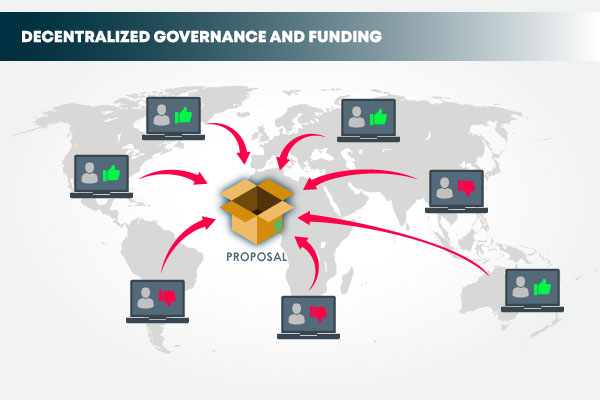
- So, what happens when a proposal is approved? – Well, the main developers on that particular project start researching/coding/implementing the feature or change to the network.
- What about the rest of the funds which are not used for proposals? – The coins that are left from the 10% reward are sent to the team as budget.
As you can see Decentralized Governance is something important for every project out there. This solves the problem with governance over the network and budget funding.