Blocknet manages to implement new xRouter functionalities to their network thanks to their equivalent to masternodes – service nodes. The new implementation will provide blockchain interoperability allowing verification of blockchain records without the users having to download the full blockchain.
What is xRouter and How it Works?
The way xRouter provides its functionality to the Blocknet network is via a communication layer consisting of an inter-blockchain SPV client backend, through which the above-mentioned interoperability is achieved. The xRouter also operates on the TCP/IP level and it is compatible with any other network including public and private DLT’s from Bitcoin, IOTA, Hyperledger etc.
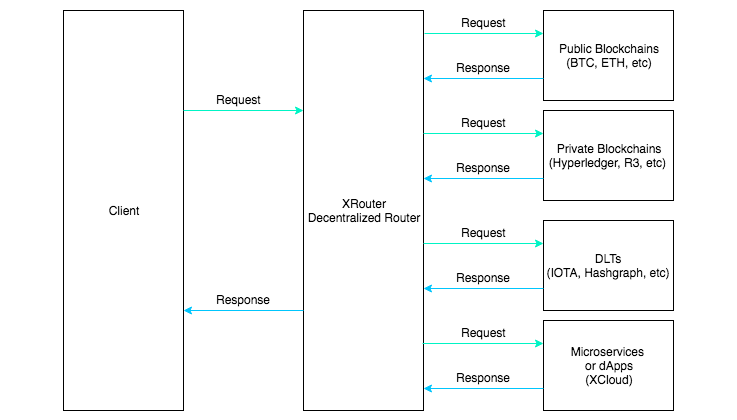
Through its utilization of the service nodes, which are the masternode equivalent in Blocknet, and routes client calls directly to the respective blockchain, dividing into two types of calls: submission calls and queries. Submissions are calls that involve interactions with a blockchain, for example xrSendTransaction. With them, the client packets are sent directly to the respective blockchain and if there is a response, then routed back. The query calls for requesting information, for example xrGetBlockCount. With them, the client packets are also routed directly to the appropriate blockchain and the response containing the requested information is returned back. These queries can require a specific amount of Service Nodes to receive the response in order to achieve a consensus. If you would like to know more about xRouter and all of the functionalities that Blocknet provides you check out their Official Documentation.
Reputation and Fee Collection for Service Nodes
Service nodes earn 100% of the fees that are collected by xBridge, xRouter and xCloud services. Each client keeps tabs on each service node locally. This is done by scoring the nodes and when a service node reaches a score of -200, it will be immediately blacklisted or banned for a day. If you are wondering how these scores are decided and what is the criteria, look at the table below:
| Action | Change in Score |
|---|---|
| Failure to respond to call within 30 seconds | -25 |
| Failure to meet majority consensus | -5 |
| Matching consensus | Correct_nodes *2 |
| Sending bad XRouter config | -10 |
| Sending bad XCloud config | -2 |
The fees are decided based on a free market. The operators of the Service Nodes can specify a fee that they are comfortable operating with, and clients can specify the maximum fee they are willing to pay. All of the fees are collected in BLOCK, but when new client releases come out, clients and operators will be able to choose different assets.
Although there is no information about the asset swaps yet, it does make sense for a wallet to connect to their own DEX, which will exchange BLOCKs for other assets. Thanks to the functionality provided by xRouters, developers can easily create cross-chain dApps and architectures without worrying too much about compatibility issues. Of course nothing will be “plug-in and play” when it goes to implication but it will be much easier than what is done right now.